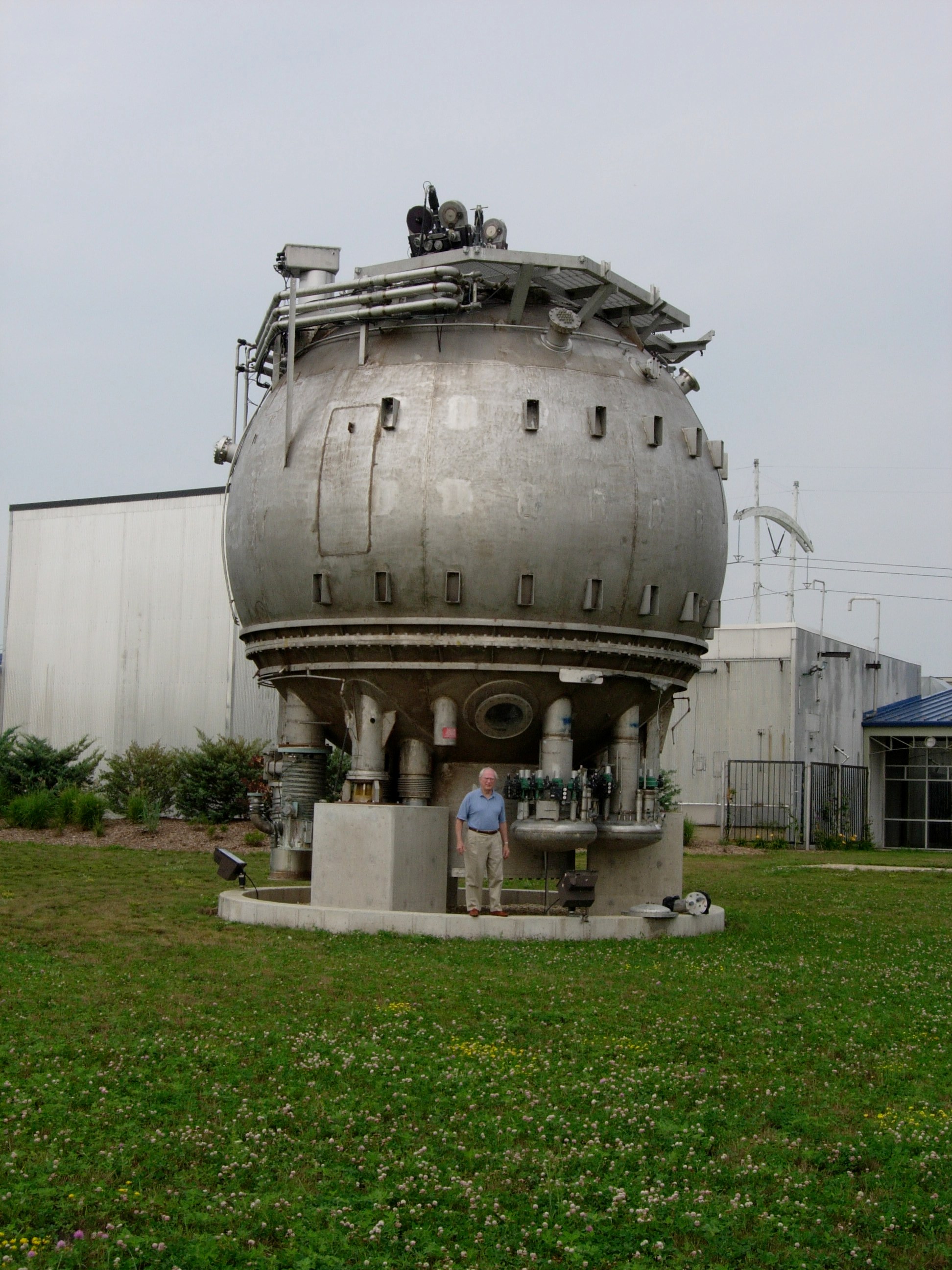
Historical highlights related to 
1952
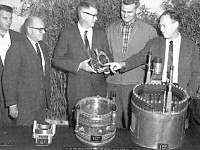
Donald GLASER invented a bubble chamber in Michigan.
The first bubble chambers were made of Pyrex glass and contained a few
cubic centimeters of liquid.
1956
Discovery
of the sigma-zero
in a propane bubble chamber with
a magnet.
1960
The 30 cm hydrogen chamber came into operation at CERN.
Bubble chambers became the main tool at CERN for the study of
resonances and strange particle physics.
1964
The 2 m hydrogen chamber came into operation at CERN.
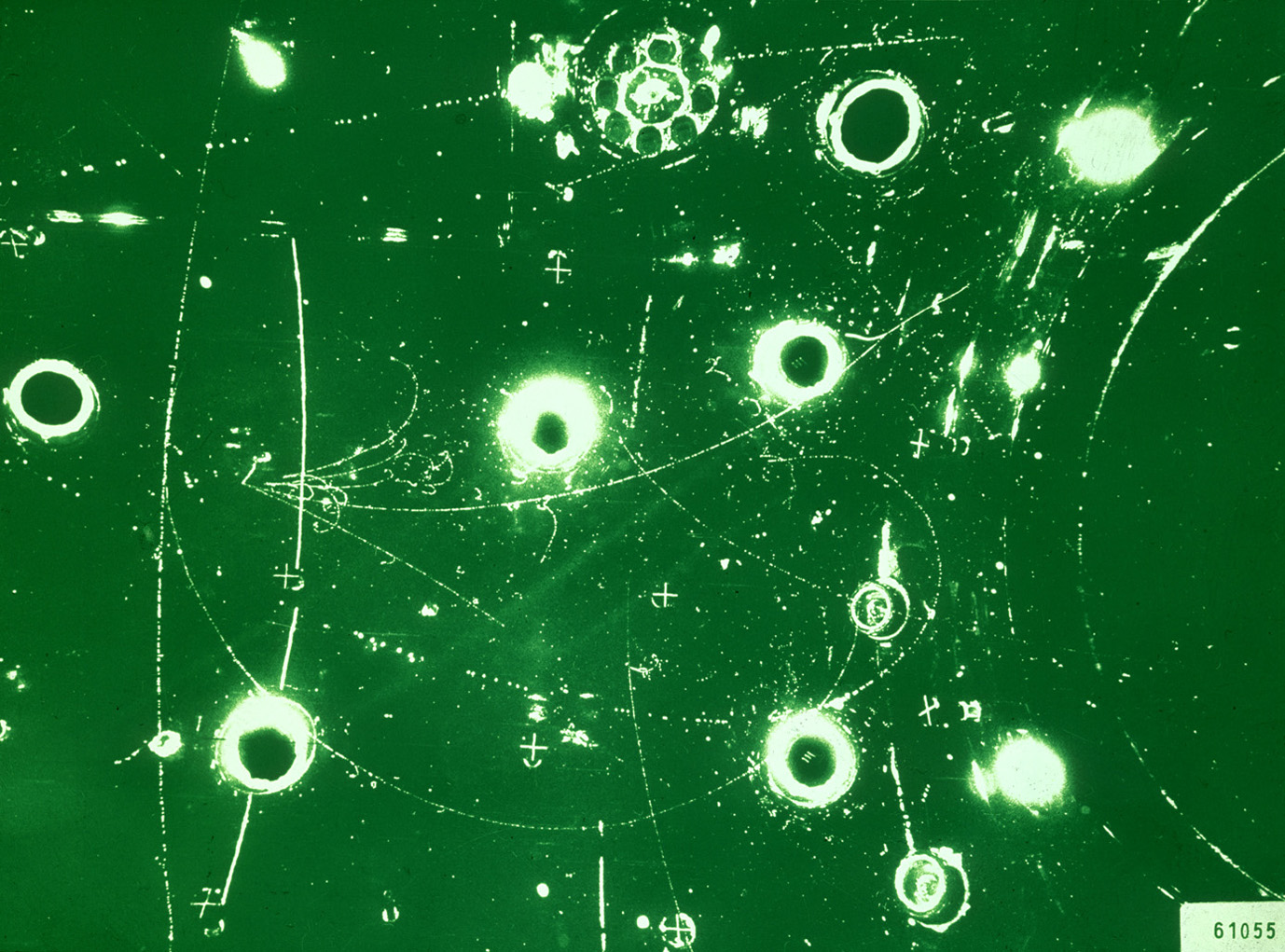
Discovery of the omega-minus particle at Brookhaven [more details]
1968
Nobel prize for Luis Walter ALVAREZ (US)
He was awarded the 1968 Nobel Prize in Physics for his discovery of a
large number of resonance states (subatomic particles that have very
short lifetimes and that occur only in high-energy nuclear collisions),
which was made possible through his development of the liquid-hydrogen
bubble chamber. [more details]
1969
Nobel prize for Murray GELL-MANN (US), for study of subatomic particles.
In 1961 GELL-MANN and Israeli physicist Yuval NE'EMAN independently
introduced the "eightfold way," or SU(3) symmetry, a table like
ordering of all subatomic particles analogous to the ordering of the
elements in the periodic table. The 1964 discovery of the omega-minus
particle (from a bubble chamber picture), which filled a gap in this
ordering, brought the theory wide acceptance and led to GELL-MANN's
being awarded the 1969 Nobel Prize for Physics. In 1963, GELL-MANN and
American physicist George ZWEIG independently postulated the existence
of the quark, an even more fundamental elementary particle with a
fractional electric charge. Quarks are confined in protons, neutrons,
and other particles. [more details]
1970
Gargamelle Bubble Chamber starts operating at CERN, very heavy liquid
(freon). 2 m diameter.
1973
Neutral currents were discovered at CERN in 25 ton Gargamelle bubble
chamber.
[more details]
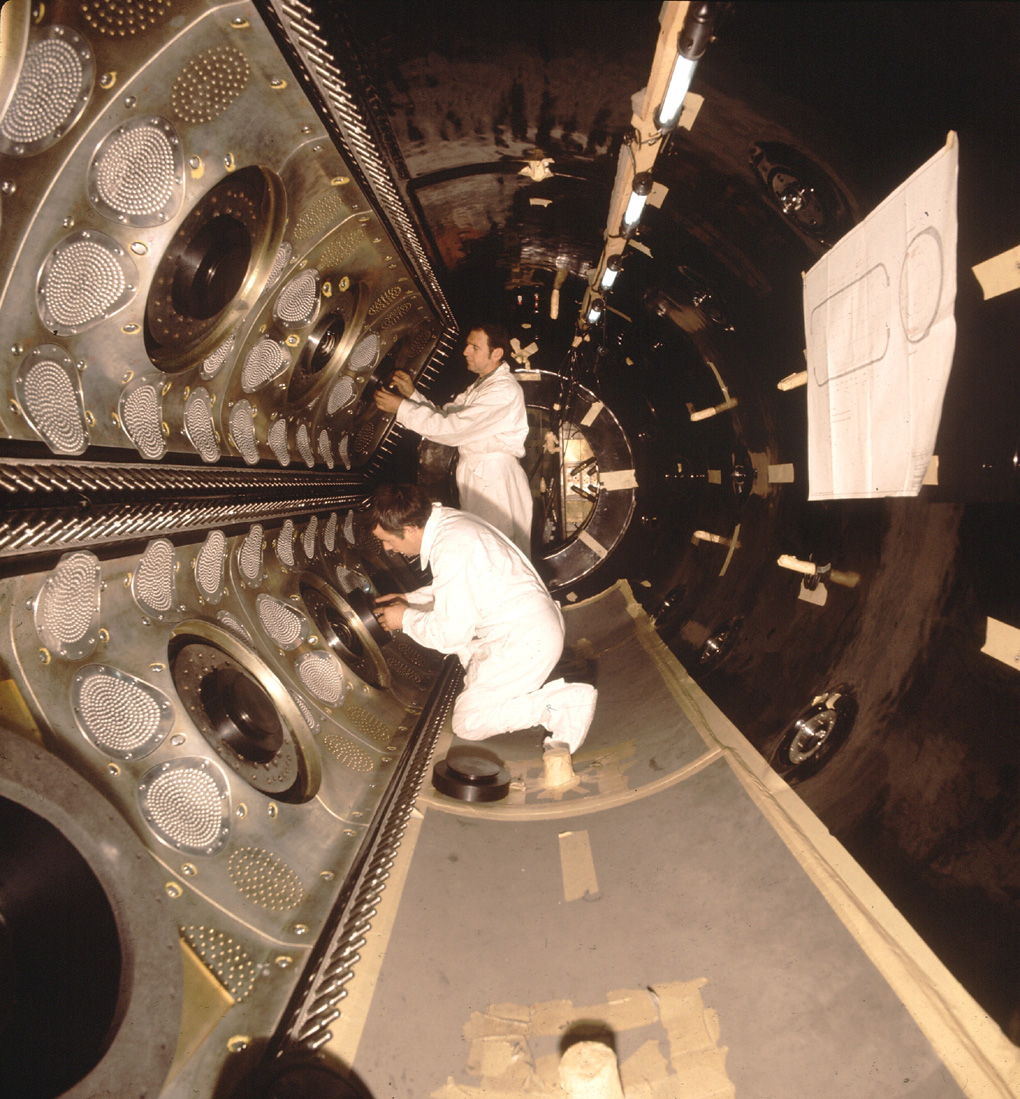
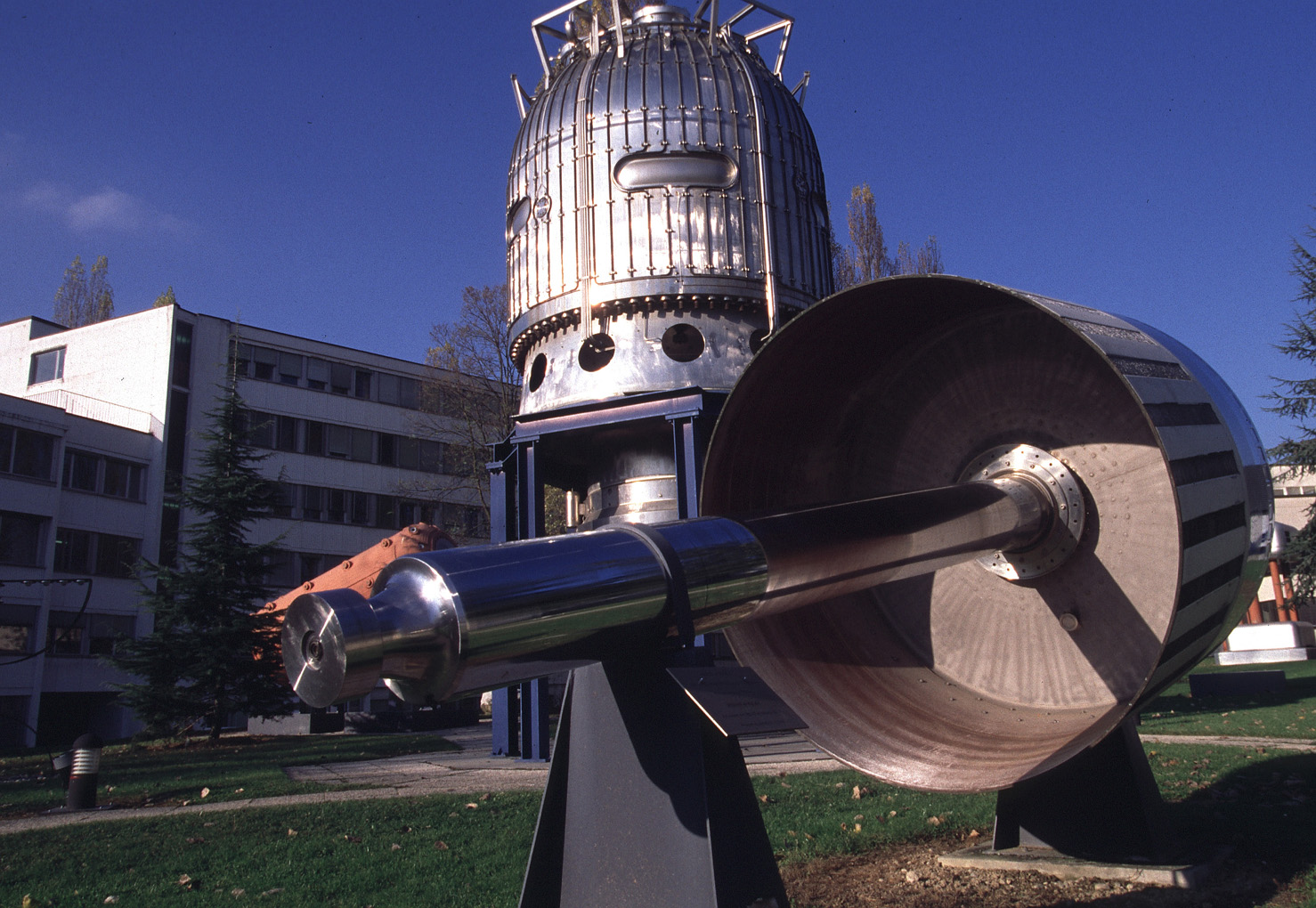
Big European Bubble Chamber (BEBC) starts operating at CERN. From 1973
to 1984 more than 6 million of photographs.
1974
7-foot Brookhaven bubble chamber started to operate.
This was the first particle detector of its type in which the chamber
through which the particles passed was surrounded by a superconducting
magnet. The following year, the 7-foot chamber was used to discover the
charmed baryon, a particle composed of three quarks, one of which was
the "charmed" quark. This result helped physicists confirm a new member
of the quark family.
In the
tracks of the bubble chamber
An article from the CERN Courier giving an overview an overview
of the impact of the bubble chamber on the emergence of the quark
substructure of mesons and baryons - a major part of the Standard Model
of particle physics. [more details]
When the bubble chamber first
burst on scene
An article from the CERN Courier by the Nobel prize winner, Jack
Steinberger,
recalling highlights of his bubble chamber days.[more
details]
Further reading
"Bubbles 40", 1994 Nuclear
Physics B (Proc. Suppl),
36.
The proceedings of a conference celebrating the contribution of the
bubble chamber to particle physics